

From Vermont Almanac, Vol. III
An ethereally whistled “spring of the year” emanates from a sea of waist-high golden hay. After scanning the field, a bird in the distance comes into focus: a yellow breasted, black necklaced, eastern meadowlark perched on a fence post. While these ground-nesting grassland birds were once widespread across Vermont, their populations have been declining for decades. Meadowlarks are now primarily found west of the Green Mountains, with only scattered populations elsewhere. In 2022 they were listed as State Threatened.
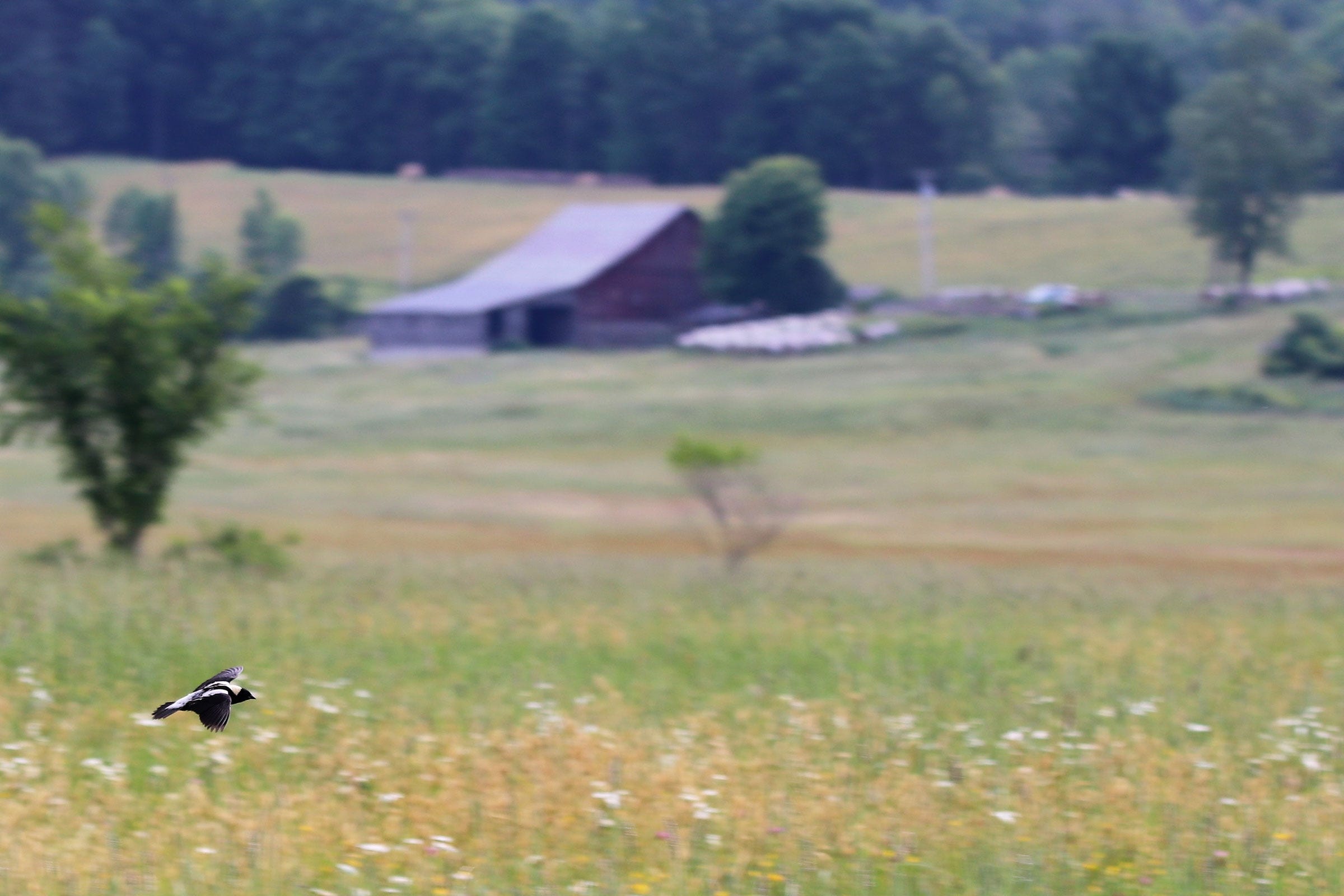
Eastern meadowlarks aren’t the only grassland species in Vermont to experience such a significant decline: breeding upland sandpipers (Endangered) are thought to be present only in single digits, while Henslow’s sparrows (Endangered) haven’t been observed in Vermont for decades. Bobolinks, while currently much more widespread than meadowlarks, are also considered a Species of Greatest Conservation Need.
These declines have been primarily driven by changes in land use throughout their breeding range. A shift in Vermont from sheep to dairy has reduced the total area of pasture. Increasingly frequent haying during June and July can destroy nests and prevent successful fledging, rendering fields as population sinks. Additionally, reforestation and development have resulted in the fragmentation and parcelization of fields, reducing the average size. A lack of active management also presents issues for grassland habitats. When fields are no longer hayed, woody shrubs grow and make the fields unsuitable for breeding within a matter of years. For grassland birds, which rely on large and unbroken tracts of hayfield, this greatly reduces available breeding habitat.
Despite their historic decline and present-day challenges, it’s not too late to stem the trend. Increased farm conservation has helped, as has “delayed haying,” a practice where farmers leave hayfields untouched between June 1 and August 1 to allow time for nesting. The strategy is to take a first cut of hay and apply manure by June 1. A farmer can then take a second cut after August 1. While this can result in lost revenue, financial incentive programs – including The Bobolink Project (bobolinkproject.com) – are available to qualifying landowners.
Hayfields and the birds that nest in them are part of Vermont’s agricultural history and identity. By working together and conserving grassland habitat when feasible, we can protect these species well into the future. Join me in appreciating these species, and being an ambassador for their conservation.
– Kevin Tolan