


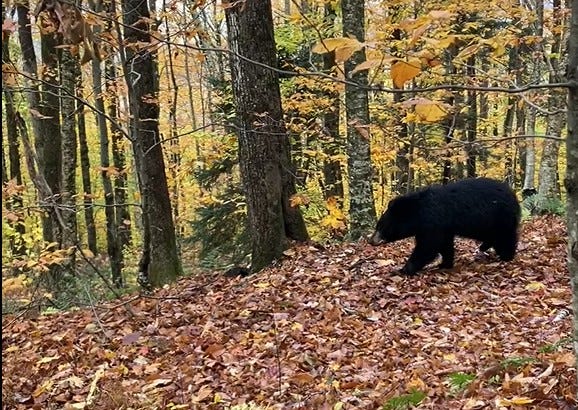
A friend shot a 70-pound bear the other day, and in relaying the story, because that’s what hunters do this time of year . . . Anybody getting anything up on the mountain?” “So and so shot a 6 on opening day of bow; so and so got a bear.” “How big?” “Little. 70 pounds.” . . . That’s how it goes. But as I was saying, in relaying the story, there’s often been a judgmental reaction. “Geeze. My dog weighs 70 pounds.” That sort of thing.
My knee jerk response in these sorts of exchanges is to point out that field-judging a bear can be hard. Anyone can tell if a bear is really big – you’d know a 500-pound bruin that was walking through the woods. And anyone can tell that a 30-pound cub is really small. But there’s a big ambiguous middle ground, especially with female bears, who are round balls of fat this time of year. They look like they should be heavier than they are, but they’re squat and short, so even a mature female might weigh only 100 pounds. And in the field, the bears don’t stand still and let you put them on a scale. You have a second or two to make a life and death decision and then you’ve got to live with the weight of that. That’s part of what makes hunting the rich experience that it is.
There’s a philosophical point around size to make here, too, in that if you’re legally hunting for food, which on the hunting ethics scale is highest and best practice, why does it matter how big the bear is anyway? You’re after the meat. I’m not going to extol the virtues of hunting and procuring wild food and then criticize someone for legally shooting an animal that’s on the small side. I butchered three hogs last weekend and no one was interested in how long they were or how much they weighed. And yet with hunting, there’s this inclination to want to know and then to judge. Part of this stems from the fact that many of us hunters need to measure ourselves against something, which has a light side when wielded honestly, but can have a darker, more ego-driven side too.
I went out bear hunting myself the other day – it was one of those days that just felt fated. There’s this sixth sense you get as a hunter where you suspect you’ll get an opportunity; some ripple in the cosmos you can feel. And sure enough, around 10 a.m. this hard-to-judge bear walked by (see video above). I was there to get meat, and yet my first impression of the bear was that she was small, which gave me pause. She was rounder than long, so I suspected she was a female. Was she a yearling? A small, mature female with a cub behind her? Something felt off to me, so without even really thinking about it, I whipped out my phone and shot her with a camera instead of the gun. When she saw me we were less than 10 yards from each other, and she put her head down as if I might disappear if she averted her eyes. Then she did a slow, sneaky turn and crept away for a few steps, hoping maybe I hadn’t noticed her, before disappearing forever.
If you’re not a hunter you might imagine that hunting is a pretty black and white affair – animal walks by, you shoot it. But for a lot of hunters, there’s a decision that has to made first, and it’s often not clear-cut. Do you shoot the 4-pointer on opening day of deer season, knowing that it’s the only buck you can harvest? Do you shoot a small animal? Do you consider family dynamics and leave a fawn or a cub motherless going into winter? Years ago I wrote a newspaper column about a bowhunter who was struggling trying to decide whether to shoot a doe who was with a fawn. The whole column focused on the arguments for and against that were running through the fictitious hunter’s head. And it generated some pointed letters to the editor from the meat-hunting community. One guy wrote “why the hell even go if you’re not going to shoot?” I tweaked that quote to make it nicer than it actually was, but regardless, there’s a fair question here. Why tell your family that you’re going out to try to get bear meat, wake up at 4 a.m., walk several miles up a mountain with a gun, and then sit there with your phone in your hand when the time comes to deliver?
There’s a philosophical answer here, too, in that restraint is more often than not a good default position with anything in life. And I could extol the sound, ethical hunting motivations beyond meat. But the most honest answer I could probably give the what-the-hell-are-you-doing-out-there guy if he’s reading this column is that there was no grandiose, stake-in-the-ground logic or personal philosophy in this moment. I was just being human.
Bear with me as I make an abstract point that circles back to hunting, but my eight-year-old daughter is into Pat Benatar (I’m over the moon about this considering her peer group’s infatuation with the K-Pop Demon Hunters soundtrack), and if you listen to Pat’s music, you hear 80’s girl-power anthems delivered in a snarl followed by songs about her heart in pieces on the ground. We were listening to an album while we were doing the dishes the other night, and I made some snide comment about the dissonance between these lyrics, to which my partner said something to the effect of: certainly a woman can be tough and also be vulnerable. I quickly backpedaled and said, yes, of course that’s true because, yes, of course it’s true – I made sure my daughter heard me say it. There’s a hunting parallel here: certainly a hunter can pursue game for meat and also decide not to pull the trigger. This world we live in wants to put us in little ideological boxes. We’re supposed to be meat hunters, or trophy hunters, or what box do you want to put me in? What culture war do you want to use my experience to fight? But that’s so disrespectful to the human experience. Hunters are complicated and sometimes contradictory – they’re people. There’s no script out there, which is a big part of what draws us to the pursuit in the first place.
– Dave Mance III
There are so many compelling reasons to “hunt” and not just for the food.